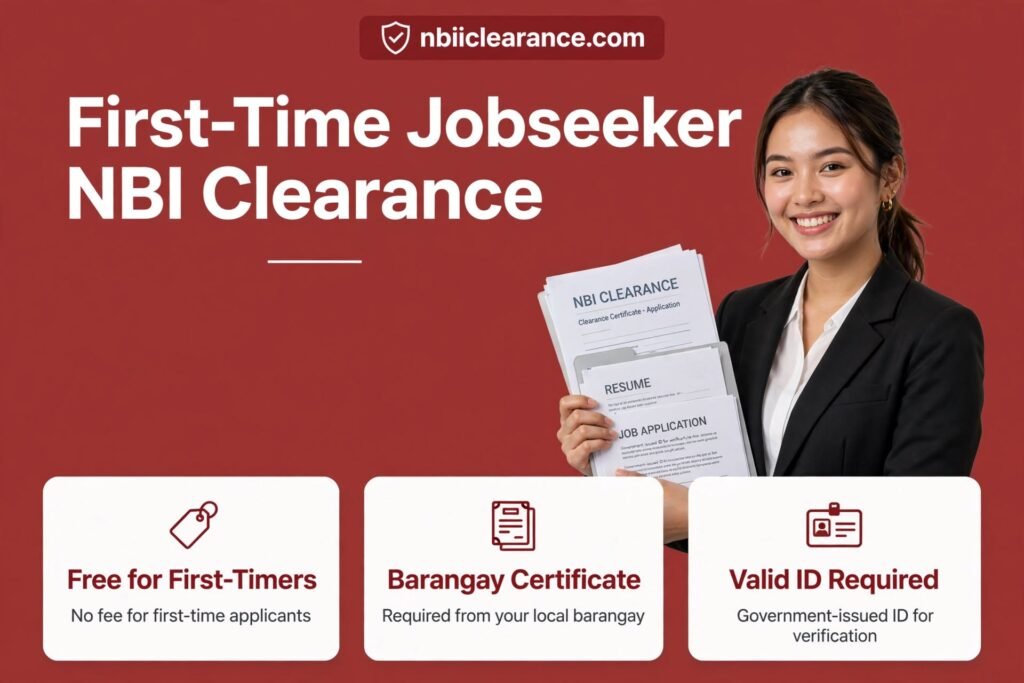
First-Time Jobseeker NBI Clearance
Best Apply Guide 2026
Applying for your first job in the Philippines almost always means collecting a pile of government documents before an employer will even look at your application. The NBI Clearance sits at the center of that pile but it is not the only document you can get for free as a first-time jobseeker. This guide walks through the First-Time Jobseeker NBI Clearance process from start to finish along with the wider set of documents covered under the law behind it so you know exactly what to prepare, where to go and what to expect at every step.If you are applying as a first-time jobseeker you can get your NBI Clearance for Foreigners in the Philippines for free – check out our complete guide here.
What Is First-Time Jobseeker NBI Clearance
A First-Time Jobseeker NBI Clearance is the same official NBI Clearance every employer asks for except the government fee is waived for applicants who are entering the workforce for the very first time. The clearance itself proves that a person has no criminal record or pending case on file with the National Bureau of Investigation. What makes the first-time jobseeker version different is not the document itself but the cost and the application path used to get it.
Understanding RA 11261 The First-Time Jobseekers Assistance Act
The legal basis for this benefit is Republic Act No. 11261 known as the First-Time Jobseekers Assistance Act signed into law in 2019. The law was authored to remove a very specific financial barrier: government agencies were charging fees for employment documents to people who by definition had no income yet since they had never been employed.
Under RA 11261 concerned government agencies are required to waive fees and charges on documents needed for a first job application and only once per person in a lifetime. Any government employee who unduly refuses to comply can face administrative sanctions while anyone who falsifies their first-time jobseeker status can be held liable under the Revised Penal Code so honesty matters on both sides of the counter.
What Documents Are Covered Under RA 11261
The NBI Clearance is the most commonly used benefit under this law but it is part of a longer list of documents lawmakers intended to make free for first-time applicants. Here is a general breakdown of what is typically covered and what is excluded.For the latest and official information please visit the official NBI website.
| Covered (Fee Waived) | Not Covered (Still Paid) |
|---|---|
| NBI Clearance | Passport application and DFA red ribbon authentication |
| Police Clearance | Driver's License (LTO) |
| Barangay Certification and Clearance | Professional Regulation Commission licensure exam fees |
| PSA Birth Certificate | Civil Service Commission exam fees |
| Certificate of Indigency (where applicable) | |
| Tax Identification Number (BIR) | |
| Unified Multi-Purpose ID (UMID) | |
| PhilHealth ID | |
| Transcript of Records or Diploma from state universities and colleges | |
| Medical Certificate from a public hospital (lab tests may still carry a fee) |
A quick note on postal ID: some local implementations include it among free jobseeker documents but this is not guaranteed everywhere so it is worth confirming directly with your local post office branch. Passport applications on the other hand are explicitly excluded from this law regardless of location.
Who Qualifies for Free NBI Clearance in the Philippines
To qualify as a first-time jobseeker under RA 11261 you generally need to meet these conditions:
- ✓ You are a Filipino citizen at least 18 years old.
- ✓ You have never been employed before in either the formal or informal sector.
- ✓ You are a resident of the barangay where you are applying, usually for at least six months.
- ✓ You can present a Barangay Certification confirming your first-time jobseeker status.
- ✓ You are actively seeking your first job.
A question that trips up a lot of fresh graduates is whether school-based work counts against them. A required on-the-job training or practicum completed purely for academic credit and either unpaid or given only a small allowance generally does not count as prior employment. This means most graduates finishing mandatory OJT hours can still apply as first-time jobseekers once they start job hunting for real.
If you have any history of formal or informal paid work however you will not qualify and the barangay may decline to issue your certification. Being upfront about your work history from the start avoids bigger problems later.
Step 1: Barangay Certification for Jobseekers
Everything under RA 11261 starts at your Barangay Hall. Here you request a Barangay Certification declaring that you are a genuine first-time jobseeker.
In most areas you will also sign an Oath of Undertaking confirming that your declaration is accurate and that you understand the responsibilities that come with the benefit.
Bring a valid ID and, if you have one, something showing you recently finished school such as a diploma or school ID.
Step 2: LGU or PESO Registration
Depending on your city or municipality, the next step may involve registering with your Local Government Unit's Public Employment Service Office, commonly called PESO.
PESO is generally responsible for supporting jobseekers at the local level and may help match applicants with available job opportunities once their documents are ready.
At PESO, you may need to complete a basic jobseeker registration form, present your Barangay Certification, and receive a referral or certificate for use with other agencies, including the NBI.
Step 3: Apply Through the NBI's Online Portal
Once your Barangay Certification is ready, you can begin your NBI Clearance application online. First-time jobseekers should make sure they select the appropriate first-time jobseeker option when applying.
The general online application process includes the following steps:
- Go to the official NBI website and register for a new account if you do not already have one.
- Enter your full name, birth date, address and contact details accurately according to your valid identification documents.
- Verify your account using the One-Time Password (OTP) sent to your registered mobile number.
- Select the first-time jobseeker option where applicable to identify your application for the fee waiver.
- Choose your preferred NBI branch and select an available appointment date and time.
Step 4: Visit the NBI Branch
New applications, including first-time jobseeker applications, generally require an in-person visit for biometric capture and photo taking.
On the day of your appointment, bring the following:
- Your appointment confirmation, either printed or available on your phone.
- Your Barangay Certification and Oath of Undertaking.
- At least one valid original government-issued ID.
- If applicable, a PSA birth certificate together with a school ID or other supporting identification.
- Any referral document from PESO if required in your area.
At the branch, staff will verify your appointment and documents, process the applicable fee waiver if required, and proceed with fingerprint scanning and photo capture.
NBI Clearance Validity for Employment
Once issued an NBI Clearance is valid for one year from its date of issuance whether it was obtained for free or at the regular fee. Many employers accept a clearance at any point within that one-year window though some prefer one issued within the last three to six months so timing your application close to your actual job search works in your favor.
Keep in mind that your Barangay Certification also has its own validity generally around one year so you should complete your NBI application and any other free documents you plan to claim within that window.
How Many Times Can You Use the Free NBI Clearance
The free NBI Clearance under RA 11261 can only be used once in a lifetime. It applies to your very first clearance as a genuine first-time jobseeker, not to every clearance you will ever need. Once you have used the benefit whether for one copy or as part of one application it cannot be claimed again under a different name location or later date.
What Happens If You Already Used Your Free NBI Clearance
If you have already availed of the free clearance once any future NBI Clearance you need whether for a new job a renewal or an overseas application will be processed at the regular fee. This applies even if very little time has passed since your first free clearance. The NBIs system checks for prior use so attempting to claim the benefit again under different details can flag your application rather than help it move faster.
Can OFWs or Foreigners Apply as First-Time Jobseekers
Filipinos applying for their first job abroad are generally still covered under RA 11261 meaning the NBI Clearance fee waiver applies to genuine first-time jobseekers pursuing overseas employment as well. The one notable exception is passport-related fees. Passport applications along with red ribbon authentication from the Department of Foreign Affairs are explicitly excluded from the law and must still be paid at the standard rate.
Foreigners residing in the Philippines can generally apply for a regular NBI Clearance but the first-time jobseeker fee waiver under RA 11261 is specifically designed for Filipino citizens entering the local or overseas workforce for the first time.
Common Mistakes First-Time Jobseekers Should Avoid
A few recurring issues cause unnecessary delays for first-time applicants:
Frequently Asked Questions
First-Time Jobseeker NBI Clearance FAQs
What is a First-Time Jobseeker NBI Clearance?
How can first-time jobseekers get free NBI Clearance?
Who qualifies for free NBI Clearance in the Philippines?
What documents are needed for first-time jobseeker NBI Clearance?
Is NBI Clearance free for first-time jobseekers?
How to avail RA 11261 benefits?
Where to apply for first-time jobseeker NBI Clearance?
How many times can I use free jobseeker NBI Clearance?
Do I need a Barangay Certificate for free NBI Clearance?
How long is free NBI Clearance valid for jobseekers?
What happens if I already use my free NBI Clearance?
Can OFWs or foreigners apply as first-time jobseekers?
Final Thoughts
The First-Time Jobseeker NBI Clearance process exists to remove one of the more frustrating hurdles new graduates and first-time applicants face: needing money to prove you deserve a paying job. Once you understand the sequence barangay certification first then the correct NBI application path followed by your branch visit the process becomes fairly straightforward. Since the benefit only applies once in a lifetime it is worth using it carefully and keeping copies of every document along the way, so your very first NBI Clearance becomes one less thing standing between you and your first paycheck.