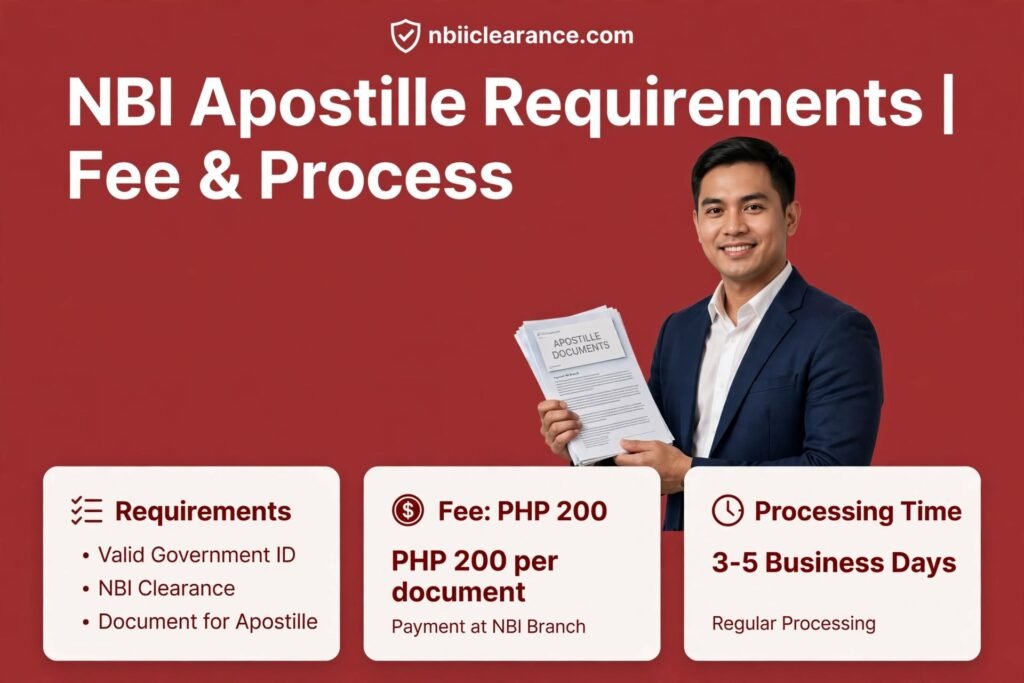
NBI Apostille Requirements Fee and Process
The Complete 2026 Guide
A standard NBI Clearance works fine for local job applications, business permits and most transactions within the Philippines. The moment you need to use it abroad for a work visa immigration paperwork overseas study, or a foreign employer’s background check, a plain NBI Clearance usually is not enough on its own. Most foreign governments and agencies want proof that the document is genuine and that proof comes from a separate authentication step called an apostille.
This guide covers everything involved in getting your NBI Clearance apostilled: what the term actually means, who handles it, the documents you need, the exact steps to follow current fees and how long the whole thing takes from start to finish.
For more helpful information about NBI Clearance forms and requirements explore our NBI Clearance Blog for related guides, useful tips and the latest updates.
What an Apostille Actually Is
An apostille is a form of official authentication attached to a public document confirming that the document is genuine and was issued by a legitimate authority. It exists specifically for documents that will be used in a different country than the one that issued them since a foreign government generally has no direct way to verify a document from another country’s system on its own.
The apostille itself takes the form of a certificate usually attached to the back of your NBI Clearance containing a reference number, the issuing authority details and a QR code that foreign agencies can use to verify it directly against an online database. Once apostilled your NBI Clearance is recognized as authentic by any country that is a member of the 1961 Hague Apostille Convention without needing further authentication through that country’s embassy or consulate.
Why the Philippines Uses Apostille Instead of Red Ribbon
Applicants who have gone through this process years ago, or who have heard about it from older friends and relatives may remember a different term entirely: red ribbon authentication. Before 2019 documents intended for use abroad went through a multi-step legalization process at the Department of Foreign Affairs which included attaching a literal red ribbon to the document as part of that older authentication method.
The Philippines joined the Hague Apostille Convention on May 14-2019 which replaced the older red ribbon system with the apostille process used today. The apostille is generally simpler and faster than the old system since it involves a single authentication step recognized across all member countries of the convention rather than requiring separate legalization through each country’s local embassy.
If you are working from an older guide or advice from someone who went through the process before 2019 it is worth knowing that red ribbon authentication is no longer how this works and any reference to it applies to the previous system rather than the current apostille process.
Who Handles the Apostille Process
A common point of confusion is assuming the NBI itself apostilles the clearance. It does not. The Department of Foreign Affairs commonly known as the DFA is the government agency responsible for issuing apostilles in the Philippines, not the NBI. The NBI issues the original clearance certificate and the DFA is a separate step afterward that authenticates that certificate for use abroad.
This means the apostille process happens at a DFA office or an authorized DFA Apostille Service Center not at an NBI branch and it requires its own separate appointment payment and set of requirements distinct from the ones you followed to get your NBI Clearance in the first place.For the latest and official information please visit the official NBI website.
Who Actually Needs an NBI Apostille
Not every NBI Clearance holder needs to go through this extra step. An apostille becomes necessary specifically when the clearance will be used outside the Philippines for an official purpose. Common situations include applying for a foreign work visa immigration or permanent residency applications, enrolling in a study program abroad, getting married in another country, adopting a child through an international process or satisfying a foreign employer background check requirement as part of an overseas job offer.
If your NBI Clearance is only going to be used for something entirely domestic: a local job, a Philippine business permit or a transaction with a Philippine government office, an apostille is unnecessary. The extra authentication step exists purely to make the document recognizable and trustworthy to a foreign authority.
Requirements for Getting Your NBI Clearance Apostilled
Before booking your DFA appointment gather the following.
Your original NBI Clearance since the DFA apostilles the physical document itself not a photocopy or a scanned version. A valid government-issued ID with the details matching what appears on your NBI Clearance exactly since any mismatch can cause delays or rejection at the counter. Proof of your DFA appointment confirmation since walk-in applicants are not accommodated at DFA Apostille Service Centers and a confirmed online appointment is required before you can be processed. Payment for the apostille fee generally settled at the DFA cashier during your appointment rather than in advance online.
If you are applying through an authorized representative rather than appearing in person additional documents are required covered in more detail further below.
How to Get Your NBI Clearance Apostilled
Here is the full process from booking your appointment to collecting your finished document.
Step-by-Step
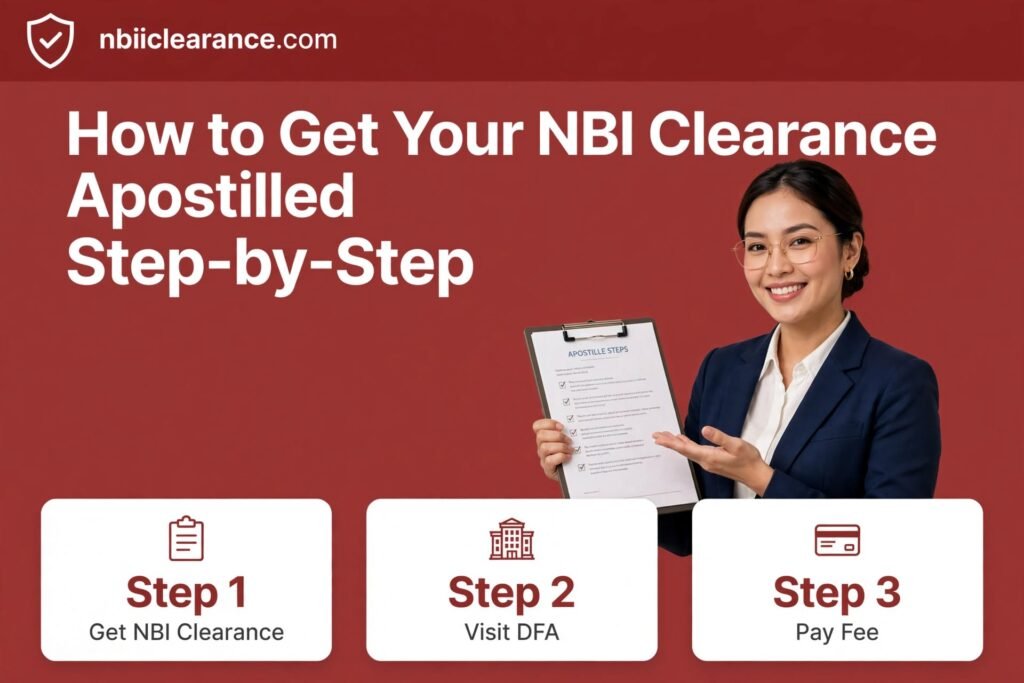
Book your DFA appointment online
Visit the official DFA appointment system and select the apostille service rather than a passport-related appointment since both are booked through overlapping portals but lead to different queues. Choose a DFA office or Apostille Service Center convenient for you then pick an available date and time.
Prepare your documents ahead of your appointment date
Make sure your original NBI Clearance is in good physical condition, since a damaged faded or unreadable clearance can be rejected at the counter requiring you to secure a fresh copy from the NBI before returning. Bring a valid ID matching your NBI Clearance details.
Arrive at the DFA office on your scheduled date
Get there with enough time before your slot since DFA offices generally ask applicants to arrive slightly early rather than exactly on time.
Fill out the apostille request form
This is typically provided at the counter and asks for basic details about the document being authenticated and its intended country of use.
Submit your documents and pay the fee
Hand over your original NBI Clearance your valid ID and your completed request form at the designated counter. Payment is generally made directly at the DFA cashier during your visit.
Receive your claim stub
This slip includes your reference number and the date your apostilled document will be ready for release.
Return on the release date to claim your document or arrange courier delivery
Many DFA offices offer a courier delivery option for an additional fee which saves you a second trip if you would rather not return in person.
NBI Apostille Fees in 2026
Pricing depends mainly on whether you choose regular or express processing along with any optional courier delivery.
| Item | Approximate Fee |
|---|---|
| Apostille fee – regular processing | Around ₱100 per document |
| Apostille fee – express processing | Around ₱200 per document |
| Courier delivery (optional) | Around ₱150 to ₱200 |
| Special Power of Attorney notarization if using a representative | Around ₱200 to ₱500 |
Keep in mind this fee is separate from the NBI Clearance fee itself which is paid earlier when you first apply for or renew your clearance. The total cost of the entire journey from a fresh NBI Clearance to a fully apostilled document ready for use abroad generally includes both the NBI fee and the DFA apostille fee added together plus any optional delivery or representative-related costs.
Since government fees are adjusted from time to time, treat the amount shown at the DFA cashier or on the official booking portal as the final word rather than relying on a number from an older article.
How Long the Apostille Process Takes
Processing time depends on which service tier you choose at the DFA.
| Processing Option | Typical Turnaround |
|---|---|
| Regular Processing | 3 to 4 working days |
| Express Processing | 1 to 2 working days |
| Courier Delivery Added on Top | A few additional days depending on your location |
This timeline covers only the DFA apostille step itself assuming you already have a completed valid NBI Clearance in hand before your DFA appointment. If you are starting from zero meaning you do not yet have an NBI Clearance at all you will need to factor in the standard NBI processing time first same day if there is no hit or several additional business days if a hit needs to be resolved before you can even book your DFA apostille appointment.
Altogether a realistic total timeline from a fresh NBI application to a fully apostilled document typically runs anywhere from about one to three weeks depending on your NBI processing outcome, your chosen DFA processing tier and whether any delays come up along the way
Applying Through a Representative
If you cannot personally visit the DFA whether due to being based abroad already a scheduling conflict or another reason you can authorize someone else to submit and claim your apostille on your behalf. This requires a Special Power of Attorney commonly abbreviated as an SPA specifically authorizing that individual to act for you in this transaction.
The SPA needs to be properly notarized and if it was executed while you were physically outside the Philippines it generally needs to be authenticated or apostilled itself in the country where you signed it before your representative can use it at the DFA. Your representative will also need to present their own valid ID alongside the SPA and your original NBI Clearance when submitting your documents.
Because this route involves an extra layer of documentation it is worth starting the SPA preparation well ahead of your intended DFA appointment date particularly if it needs to be authenticated abroad first since that step alone can add processing time before your representative is even ready to proceed at the DFA counter.
Apostille for OFWs and Applicants Already Abroad
Overseas Filipino Workers and other Filipinos already living abroad have a couple of practical paths available depending on whether they still have contacts in the Philippines who can help.
One option is applying for the NBI Clearance itself while abroad through the online portal then having the clearance either mailed directly to a Philippine-based representative or coordinated through the nearest Philippine Embassy or Consulate followed by that representative handling the DFA apostille step domestically using an SPA. Another option available in some cases involves working through the Philippine Embassy or Consulate abroad directly since certain postings offer authentication services or can guide applicants toward the correct process for their specific country and circumstances.
Given that this path involves more moving parts coordinating between overseas applicants and a representative in the Philippines it generally takes longer than the standard domestic process so building in extra weeks ahead of any visa or immigration deadline is a sensible precaution.
Common Reasons Apostille Applications Get Delayed or Rejected
A handful of avoidable issues account for most of the problems applicants run into during this process.
Submitting a damaged faded or otherwise unreadable NBI Clearance is one of the most common causes of rejection at the counter since the apostille certificate is physically attached to the document and requires it to be in presentable verifiable condition. Mismatched personal details between your NBI Clearance and the ID you bring to the DFA is another frequent issue similar to the kind of mismatch that can delay an NBI application itself. Attempting a walk-in visit without a confirmed DFA appointment will simply not be accommodated at most Apostille Service Centers since appointments are required rather than optional. Using an expired NBI Clearance meaning one older than a year from its issue date, generally cannot be apostilled at all since the underlying document itself is no longer considered current.
For applicants using a representative, an improperly executed or unauthenticated SPA is a common stumbling block particularly for SPAs signed abroad that were not properly authenticated in that country before being brought to the Philippines.
Apostille Versus the NBI Clearance Itself
Understanding the Difference
It helps to be clear about what each document actually represents, since the two are related but distinct steps in the same overall journey. The NBI Clearance itself is the background check certificate confirming whether a person has any pending criminal case on file within the Philippines. The apostille is a separate authentication layer added afterward confirming to a foreign government that the NBI Clearance is a genuine document issued by a legitimate Philippine authority.
You cannot skip straight to an apostille without first having a valid NBI Clearance since there is nothing to authenticate without the underlying document. Likewise a valid NBI Clearance without an apostille is often not accepted by a foreign government or employer specifically because it lacks that additional layer of international authentication they are looking for.
How to Verify an Apostilled Document Is Genuine
Since the entire purpose of an apostille is to reassure a foreign authority that a document is legitimate the DFA maintains an online e-Apostille verification system where the receiving party, whether a foreign embassy employer or government office can check the authenticity of an apostille certificate using its unique reference number. This system allows anyone abroad reviewing your documents to independently confirm that the apostille was genuinely issued by the DFA without needing to contact the Philippines directly or rely solely on the physical document in hand.
Keeping your claim stub and reference number after collecting your apostilled document is worth doing for this reason since it gives you a quick way to confirm your own documents status if a receiving foreign office ever has a question about it.
Preparing for Multiple Documents at Once
If you need more than just your NBI Clearance apostilled for instance alongside a birth certificate, marriage certificate or educational diploma for the same visa or immigration application it is generally possible to submit multiple documents during the same DFA appointment. Each document is treated and charged separately meaning the apostille fee applies per document rather than as a single flat charge covering everything you bring.
Organizing all of your documents together ahead of time confirming each one is an original or a properly certified copy where required and double-checking that personal details are consistent across all of them can save you a considerable amount of back-and-forth compared to handling each document through a separate appointment.
Budgeting Beyond Just the Apostille Fee
Many applicants budget only for the apostille fee itself and are caught off guard by additional costs that come up along the way. Transportation to and from the DFA office particularly for applicants outside Metro Manila who may need to travel to a regional Apostille Service Center courier fees if you choose delivery over a second in-person visit notarization costs if an SPA is involved and potential reprocessing costs if a document is rejected and needs to be replaced or resubmitted can all add up beyond the base apostille charge.
Building a small buffer into your budget and timeline for these secondary costs tends to make the overall experience considerably less stressful than assuming the apostille fee alone represents the full cost of the process.
Choosing Between Regular and Express Processing
Deciding between regular and express apostille processing usually comes down to how tight your timeline is. If you have a few weeks of buffer before you need the apostilled document, regular processing at around ₱100 per document is the more economical choice since the only real trade-off is waiting an extra day or two compared to express.
Express processing at roughly double the fee makes more sense when you are working against a firm deadline such as an upcoming visa interview, a flight booking or an employers document submission cutoff. The time saved typically one to two days compared to regular processing can matter significantly if your schedule has little room for unexpected delays elsewhere in the process such as a longer than usual queue at the DFA office itself.
It is worth noting that choosing express processing at the DFA does not speed up anything on the NBI side of the process. If your NBI Clearance itself is still pending particularly if a hit needs to be resolved express DFA processing only shortens the apostille portion of your timeline not the earlier steps that come before you are even ready to book a DFA appointment.
What to Do If Your Apostille Application Gets Rejected
Occasionally an application is rejected at the DFA counter most commonly due to a damaged NBI Clearance, a mismatched ID or an incomplete SPA for representative-based submissions. If this happens staff will typically explain the specific reason for the rejection giving you a chance to correct the issue rather than leaving you without any path forward.
For a damaged or unreadable NBI Clearance your next step is usually returning to the NBI to request a reprint or in some cases a fresh renewal if the original has deteriorated significantly. For a mismatched ID bringing an additional or more clearly matching identification document on a rescheduled visit typically resolves the issue. For SPA-related rejections having the document properly notarized and authenticated abroad if it was signed outside the Philippines before attempting to resubmit is the standard fix.
Rather than treating a rejection as a dead end it helps to think of it as a checklist correction. Once the specific issue is addressed a new DFA appointment and a fresh attempt generally moves forward without further complications.
Apostille Requirements for Specific Common Destination Countries
While the apostille itself is recognized uniformly across all Hague Convention member countries some receiving countries or specific visa categories occasionally request additional supporting steps beyond the apostille alone such as a certified translation if the destination country’s official language differs from English or Filipino or additional notarization requirements specific to that country’s immigration process.
Because these secondary requirements vary considerably depending on the destination country and the specific purpose of your application whether that is employment, marriage study or immigration it is worth checking directly with the receiving country’s embassy consulate or relevant immigration authority for any requirements beyond the standard DFA apostille itself. The apostille satisfies the authentication requirement under the Hague Convention but some countries layer additional document preparation on top of that baseline depending on the specific visa or application category involved.
Keeping Copies and Records After the Apostille Is Issued
Once you have your apostilled NBI Clearance in hand it is worth treating it with the same care you would any other important travel or immigration document. Keep a clear scanned copy stored securely separate from the physical original in case you need to reference the reference number or reprint a copy for a specific application step later on.
Since an apostilled document is tied to the validity of the underlying NBI Clearance remember that the one-year validity period still applies from the original NBI issue date not from the date the apostille itself was added. If your NBI Clearance was already several months old by the time you had it apostilled, plan your usage timeline accordingly since the apostille does not reset or extend how long the underlying document remains valid.
Add Your Heading Text Here
Does the NBI apostille my clearance directly?
No. The NBI issues the original clearance certificate. The Department of Foreign Affairs is the agency responsible for apostilling it afterward through a separate appointment and process.
Is red ribbon authentication still used for NBI Clearances?
No. The Philippines replaced red ribbon authentication with the apostille system after joining the Hague Apostille Convention in May 2019. Any current authentication for international use goes through the apostille process instead.
Can I apply for the DFA apostille without an appointment?
Generally no. Walk-in applicants are not accommodated at most DFA Apostille Service Centers. A confirmed online appointment is required before you can submit your documents.
How much does an NBI apostille cost in 2026?
Regular processing generally costs around ₱100 per document while express processing is around ₱200 per document not including optional courier delivery or representative-related costs like SPA notarization.
How long does the apostille process take?
Regular processing typically takes 3 to 4 working days while express processing takes 1 to 2 working days not counting any additional time for courier delivery if you choose that option.
Can someone else claim my apostilled NBI Clearance for me?
Yes provided they carry a properly notarized Special Power of Attorney authorizing them to act on your behalf along with their own valid ID and your original documents.
Do I need to apostille my NBI Clearance if I am only using it within the Philippines?
No. An apostille is only necessary when the clearance will be used in another country. For domestic purposes a standard NBI Clearance is sufficient on its own.
Can an expired NBI Clearance be apostilled?
Generally no. The underlying NBI Clearance needs to be valid within its one-year validity period in order to be apostilled. An expired clearance typically needs to be renewed first.
Can I apostille multiple documents in one DFA appointment?
Yes in most cases. Each document is charged its own separate apostille fee but multiple documents can generally be processed together during the same visit.
How can a foreign employer or embassy verify my apostille is genuine?
Through the DFAs online e-Apostille verification system which allows anyone to check the authenticity of an apostille certificate using its unique reference number.
What happens if my NBI Clearance is damaged when I bring it to the DFA?
It may be rejected at the counter since the document needs to be in clear readable condition for the apostille to be properly attached and verified. You would likely need to secure a fresh undamaged copy from the NBI before returning for another appointment.
Is the apostille process fully online?
Only the appointment booking portion is done online. The actual submission of your physical NBI Clearance along with payment and collection, still requires an in-person visit to a DFA office or Apostille Service Center unless you are using an authorized representative on your behalf.
Does the one-year validity of my NBI Clearance still apply after it is apostilled?
Yes. The apostille authenticates the document but does not extend or reset its validity period. The clearance remains valid for one year from its original NBI issue date regardless of when the apostille was added.
What should I do if my apostille application is rejected at the counter?
Ask staff for the specific reason then address it directly whether that means securing a fresh NBI Clearance bringing a better-matching ID or properly notarizing an SPA before booking a new appointment to resubmit.
Final Thoughts
Getting your NBI Clearance apostilled is a separate additional step from the clearance application itself handled entirely through the Department of Foreign Affairs rather than the NBI. Once you understand that distinction the rest of the process becomes fairly straightforward: book your DFA appointment, bring your original clearance and a matching valid ID, choose your processing speed and either return for pickup or arrange courier delivery.
The applicants who move through this smoothly are usually the ones who start early particularly if a visa or immigration deadline is involved, keep their NBI Clearance in good physical condition and budget for the apostille fee as a separate cost from their original clearance fee rather than assuming one payment covers the entire journey.
Fees processing times and appointment systems are occasionally updated by the DFA so it is worth confirming the latest details on the official DFA website close to your appointment date particularly if the information you are working from is more than a few months old.
Information last reviewed August 2026. Fees, requirements, and processing times may change over time; always confirm current details on the official DFA and NBI Clearance websites before your appointment.