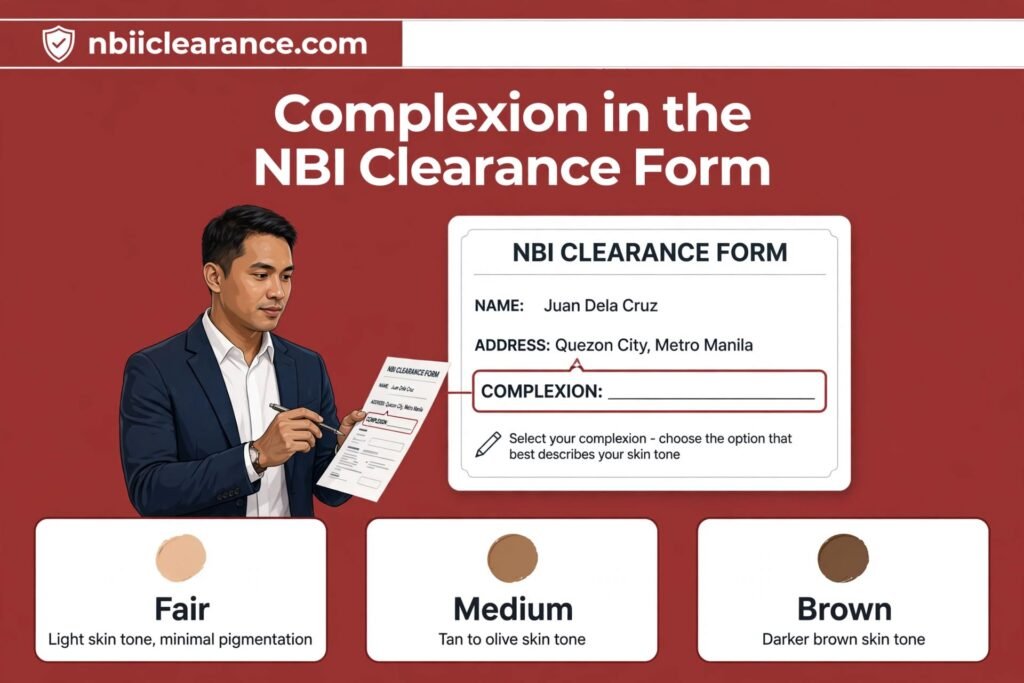
Complexion in the NBI Clearance Form
What It Means and How to Answer It
Anyone filling out the NBI Clearance registration form for the first time eventually runs into a field that catches them off guard: complexion. It sits quietly among the more familiar fields name , birthdate address and suddenly asks something a lot of applicants have never had to describe about themselves in writing before. Fair? Light? Medium? Dark? What do these words even mean in this context and does picking the wrong one cause a problem?
This article walks through exactly what the complexion field is asking why it appears on the form at all the common answer options and how they are generally understood and the small details that help you fill it in correctly the first time without overthinking it. By the time you finish reading this should be one of the quickest least stressful parts of the entire NBI application to complete.
For more helpful information about Valid IDs for NBI Clearance explore our NBI Clearance Blog for related guides, useful tips and the latest updates.
What the Complexion Field Actually Means
In the context of the NBI Clearance form complexion refers to the general tone or shade of a person’s skin. It is one of several physical description fields on the application alongside details like height, weight and any distinguishing marks or features all of which exist to help build a more complete identification profile of the applicant beyond just a name and photograph.
This is not a scientific or medical measurement. There is no chart scanner or official standard the NBI uses to determine your exact complexion. It is a self-reported field meaning you choose the description that best matches how you would generally describe your own skin tone the same way you might describe it to a tailor, a doctor filling out an intake form or anyone else asking a simple everyday question about your appearance. Once you see it in that light it becomes a lot less intimidating than it might feel the first time it appears on your screen.
Why Physical Description Fields Exist on Government Forms
Fields like complexion height and weight are a fairly standard part of identification documents and background check forms in many countries, not something unique to the Philippines or the NBI specifically. Passports drivers licenses and various government-issued IDs around the world often include similar physical descriptors.
The purpose is practical rather than judgmental. In situations where a photo alone might be unclear, outdated or difficult to match quickly a written physical description offers an additional layer of identification. If two people happen to share a very similar name small physical details recorded on file can help distinguish between records more efficiently particularly in a country with a population as large as the Philippines where name overlaps are common.
It is worth understanding that this field is not asking about ethnicity, race or any deeper personal characteristic. It is asking quite literally what shade your skin generally is in the same practical spirit as recording someone height or the color of their hair.For the latest and official information please visit the official NBI website.
Common Complexion Options on the NBI Form
While exact wording can vary slightly depending on the specific version of the form or portal update the general categories applicants commonly select from include the following.
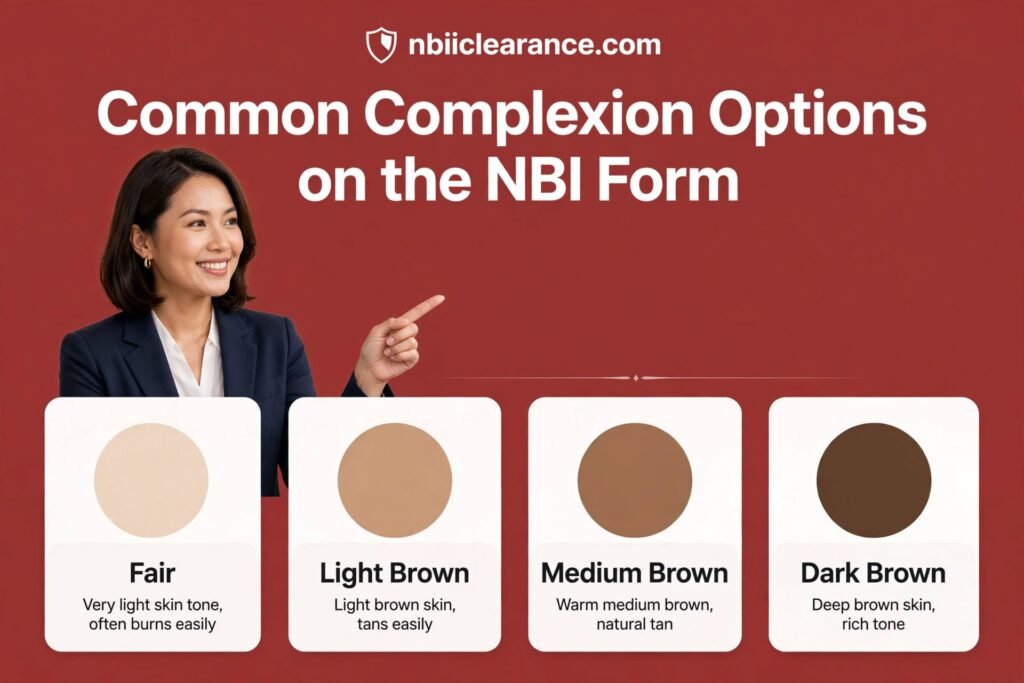
Fair
Generally used to describe very light skin tones often with a pale or pinkish undertone
Light
A step past fair still on the lighter end of the spectrum but with slightly more depth or warmth to the tone.
Medium or Fair to Medium
Often used for tones that sit comfortably in the middle range neither notably light nor notably dark and is one of the more commonly selected options among Filipino applicants given the range of skin tones typical in the population.
Morena or Kayumanggi
These Filipino terms describe a light to medium brown tone and are widely and comfortably used across Philippine culture including in everyday conversation media and official contexts so seeing them appear as an option on a government form is not unusual locally.
Brown
Used for a clearly brown tone generally deeper than morena or but not as deep as the darkest category.
Dark or Dark Brown
Used for the deepest skin tone range on the form typically the final option in the list.
Some versions of the form may combine or slightly reword these categories and a few portals present them as a dropdown list rather than free text which actually makes the choice simpler since you are picking from a fixed set of options rather than writing something in yourself and worrying about phrasing it exactly right.
How to Choose the Right Option for Yourself
For most applicants this is a far simpler decision than it initially feels. The honest answer is usually the one that comes to mind first without overanalyzing it. A few practical approaches can help if you are genuinely unsure.
Think about how you would casually describe your own skin tone to a friend or family member using the kind of everyday language people naturally use in conversation rather than trying to match yourself precisely against a color chart. If the form offers a dropdown with several options rather than open text read through the full list once before selecting since seeing all the choices together often makes the right one more obvious than picking the first option that seems close enough.
If you have filled out an NBI form before whether for a past application or renewal using the same complexion category you selected previously helps keep your record consistent over time which matters slightly more than getting the single most precise or scientifically accurate word though even inconsistency between entries is not something to lose sleep over.
Does Complexion Affect Your NBI Clearance Application?
This is probably the most common worry applicants have once they start thinking too hard about the field: does choosing fair over medium or medium over brown somehow affect whether the application is approved, delayed or flagged in any way. It is a fair question to ask especially for anyone who has heard stories about strict government processes and wants to avoid any avoidable mistake.
It does not. The complexion field is a physical description detail not a factor considered when checking your name against the criminal record database. Approval or a hit on your application depends entirely on whether your name and personal details match any existing case record in the NBI system, something completely unrelated to how you describe your skin tone. There is no scenario where selecting a particular complexion option causes your application to be treated more favorably or unfavorably compared to another.
The only situation where it matters even slightly is straightforward accuracy and consistency, the same standard applied to your height or weight entries useful for identification purposes but not something that influences your background check outcome in any way.
Can You Change or Correct Your Complexion Entry Later
If you realize after submitting your form that you selected a complexion option you would rather change or notice a difference between what you entered this time versus a previous application this is generally a minor low-stakes correction rather than something requiring extensive paperwork and it is one of the easier details on the entire form to adjust without needing to justify the change.
For most applicants simply selecting a more accurate option the next time you apply or renew is enough since the field does not carry legal weight the way something like your birthdate or legal name does. If you specifically want to correct an entry on a clearance you have already received, raising it directly with staff at your next branch visit is the most straightforward way to handle it though in practice this is rarely something applicants feel the need to formally address.
Complexion Compared to Other Physical Description Fields
It helps to see complexion in context alongside the other physical details the NBI form typically asks for since understanding the full picture makes each individual field feel less unusual on its own and it also shows how consistently the form applies the same relaxed self-reported standard across the board.
Height and weight are generally entered as approximate figures understood to be reasonably accurate rather than exact to the decimal point. Distinguishing marks such as scars, moles or birthmarks are optional in many versions of the form and exist purely as an additional identification aid rather than a mandatory field. Eye color and hair color when included follow the same self-reported everyday-language approach as complexion.
None of these fields are treated as more important than your name birthdate or ID verification during the actual background check process. They exist as a secondary layer of identification detail useful in edge cases but not central to how your application is approved or processed.
A Brief Note on Terminology and Comfort
Some applicants feel a bit unsure or even mildly uncomfortable being asked to categorize their own skin tone on an official form which is a completely understandable reaction particularly for anyone unfamiliar with this being a standard part of many government identification documents worldwide. It can help to remember that this field is functionally similar to being asked your height or your natural hair color a practical descriptor rather than a judgment or a value statement of any kind.
In the Philippine context specifically terms like morena and generally positive and widely embraced cultural association are often used affectionately in everyday language music and media rather than in any negative sense. Choosing whichever option honestly matches your own skin tone using the same relaxed approach you would in casual conversation is really all the field is asking for.
What Happens If You Skip the Complexion Field
On most versions of the NBI online form complexion is a required field rather than an optional one meaning the system generally will not let you proceed to the next step of registration until it is filled in. If you find yourself staring at the dropdown unsure of what to pick, choosing the option that feels closest to how you would describe yourself in an everyday context is the practical way forward since as covered earlier there is no wrong answer that affects your application’s outcome in any meaningful way.
If a specific version of the form does present complexion as optional leaving it blank generally has no negative consequence either though most applicants find it just as easy to select an answer as to skip past it given how low-stakes the decision actually is.
Complexion Entries for Foreign Applicants
Foreign nationals applying for an NBI clearance while residing in the Philippines fill out the same general application form as Filipino citizens including the complexion field. Since the options presented are meant to describe skin tone broadly rather than being tied to any specific nationality or ethnicity foreign applicants select whichever option most closely matches their own complexion using the same everyday judgment described throughout this guide.
There is no separate or different standard applied based on an applicant’s citizenship and the field carries the same low level of significance for foreign applicants as it does for Filipino citizens completing the same form.
Renewal Applicants and the Complexion Field
For applicants renewing an existing NBI clearance the complexion field usually appears again as part of the renewal form, sometimes pre-filled based on your previous entry and sometimes left for you to select again from scratch depending on the specific version of the portal at the time.
If it appears pre-filled, reviewing it briefly alongside your other personal details is worth doing simply as part of a general habit of double-checking your form before submitting, though as established earlier an inaccurate or slightly different complexion entry compared to a past application will not cause any issue with your renewal being processed. If you would like to update it to something you feel is more accurate doing so is straightforward and does not require any special justification or supporting document.
A Practical Walkthrough for Filling In This Field
For applicants who want a simple no-overthinking approach to this specific part of the form, here is a straightforward way to move through it quickly.
Look at the full list of options presented on your specific version of the form before selecting anything since having the complete picture in front of you tends to make the right choice more obvious than judging in isolation. Pick the description that most closely matches how you would describe yourself in an ordinary everyday conversation rather than trying to find a scientifically perfect match. If you are between two options and genuinely cannot decide either one is a reasonable choice since the field carries no weight in how your application is processed. Move on to the next field once you have made a selection without circling back to second-guess a decision that as this entire guide has aimed to make clear simply does not carry the significance many applicants initially assume it does.
The History Behind Physical Descriptors on Identity Documents
Physical description fields like complexion did not appear on identification forms by accident. Long before photographs became a standard part of identity documents, written descriptions were the primary way authorities recorded who someone was. Height build complexion, eye color and hair color made up the core of what a written identity record looked like for much of modern history and many of those same categories simply carried over into government forms even after photography became widespread and far more reliable as a primary identifier.
The NBI, like law enforcement and identification agencies in many countries, has kept a version of this older descriptive tradition alongside the photograph and biometric data it now also collects. In practice the photo and fingerprints do almost all of the real identification work today while fields like complexion remain more as a secondary supporting layer of detail rather than something the system leans on heavily. Knowing this background helps explain why the field still exists on a modern digital form even though a clear photo alone would seem sufficient to most applicants filling it out for the first time.
How Other Countries Handle Similar Fields
The Philippines is far from alone in asking applicants to self-describe their complexion or general appearance on an official form. Passport applications, drivers license forms and various identification documents across many countries include comparable physical descriptor fields sometimes phrased as complexion sometimes as skin tone and sometimes folded into a broader appearance section alongside height and build.
This international pattern is worth keeping in mind if the field feels unusual at first glance. It is a fairly ordinary longstanding practice in government identification systems generally not something specific to the NBI or unique to Philippine bureaucracy. Recognizing that this is standard practice elsewhere too can make the field feel less like an unusual or invasive question and more like routine paperwork shared across many different identification systems worldwide filled out by millions of people every year without a second thought.
Why This Field Rarely Causes Real Problems in Practice
Given how much attention this small dropdown sometimes gets from first-time applicants it is worth stepping back and looking at how it actually plays out during real appointments. Staff processing NBI applications are focused primarily on verifying your submitted ID against your registered details and running your name through the criminal record database. The complexion field sits quietly in the background of your application record referenced only in the rare edge case where a secondary physical description might help distinguish between two very similarly named individuals.
In the overwhelming majority of appointments complexion is never brought up, questioned or discussed at all during the actual branch visit. It simply exists as a data field you fill in during registration similar to how your height or weight entries are rarely a topic of conversation once you are standing at the counter completing your biometrics.
Understanding the Difference Between Complexion and Ethnicity
It is worth being explicit about a distinction that occasionally causes confusion. Complexion as used on the NBI form refers strictly to skin tone as a visual physical description comparable to noting someone’s hair color or approximate height. It is not asking about ethnicity, ancestry, regional origin or any broader aspect of personal or cultural identity.
Two people from the exact same ethnic or regional background in the Philippines can reasonably select entirely different complexion options on the form since skin tone naturally varies among individuals regardless of shared heritage. Likewise someone’s chosen complexion answer says nothing about where their family originates from or any other personal characteristic beyond the simple visual detail the field is asking about. Keeping this distinction clear tends to remove most of the hesitation applicants feel when they first encounter the field.
A Look at How the Field Has Appeared Across Different Form Versions
Since the NBIs online portal has gone through several updates over the years the exact presentation of the complexion field has shifted slightly from one version to another. Earlier paper-based application forms sometimes used open text fields where applicants wrote in their own description freely rather than choosing from a preset list. As the system moved online most versions transitioned to a dropdown menu with a fixed set of options which actually simplifies the decision for applicants since there is no need to think of the right word yourself only to recognize which listed option fits best.
This shift toward a fixed list also helps keep the NBIs internal records more consistent since a standardized set of categories is easier to work with administratively than an open field where applicants might describe the same general skin tone using dozens of different personal phrasings.
Tips for Parents Filling This Out on Behalf of a Minor
For situations where a parent or guardian is completing an NBI application on behalf of a minor the same general guidance applies to the complexion field as it would for an adult applicant. Select the option that most naturally describes the child’s skin tone using the same everyday non-technical judgment described throughout this guide. There is no need to consult a doctor compared against a formal chart or treat this decision with any more precision than you would use describing your child casually to a relative.
As with adult applications this field carries no bearing on whether the application is processed successfully so parents can move through it quickly without worrying that an imprecise entry will cause any complication for their child’s application.
Frequently Asked Questions
What does complexion mean on the NBI Clearance form?
It refers to your general skin tone described using everyday terms like fair light medium morena brown or dark. It is a self-reported physical description field similar to height or weight rather than a scientific measurement.
Does my complex answer affect whether my NBI Clearance gets approved?
No. Complexion is a physical identification detail and has no bearing on the background check itself which depends entirely on whether your name and personal details match any existing case record in the NBI database.
What if I am unsure which complexion option to choose?
Choose whichever description you would naturally use to describe your own skin tone in everyday conversation. There is no wrong answer and the field does not affect your application outcome.
Can I change my complexion entry on a future application?
Yes. Since it carries no legal weight, selecting a different option on a future application or renewal is completely fine and does not require any special explanation or correction process.
Is complexion a required field on the NBI form?
On most versions of the online portal yes it is required in order to proceed with registration. If a specific version presents it as optional leaving it blank generally has no negative consequence.
Are terms like morena and commonly used on the form?
Yes. These are widely used and culturally familiar Filipino terms describing a light to medium brown skin tone and they appear as standard options on many versions of the NBI form.
Do foreign applicants answer the complexion field differently than Filipino citizens?
No. Foreign nationals fill out the same field using the same general options selecting whichever description most closely matches their own complexion regardless of nationality.
Will an inaccurate complexion entry cause a hit or delay on my application?
No. A hit relates specifically to a possible match against a criminal record in the NBI database and has nothing to do with your physical description entries, including complexion height or weight.
Why does a government form ask about complexion at all?
It is one of several physical description fields alongside height weight and distinguishing marks that serve as a secondary layer of identification detail, a fairly standard practice on many government identification forms beyond just the NBI.
Should I use the same complexion answer every time I apply or renew?
It helps for general consistency in your record similar to keeping your height or weight roughly the same across applications though small differences between entries do not cause any actual problem with your application.
Is there an official chart or standard the NBI uses to define each complexion category?
No formal published chart exists for applicants to reference. Each category such as fair, medium or brown is understood in the same general everyday sense that these words carry in ordinary conversation rather than through any strict technical definition.
Can staff at the branch overrule or question my complexion selection?
This essentially never happens in practice since the field is self-reported and not something staff verify or challenge during your appointment. Their attention is focused on your ID verification and biometrics not on your physical description entries.
Does complexion appear on the final printed NBI Clearance certificate?
The printed certificate itself primarily displays your photo name, NBI ID number and QR code rather than a detailed physical description breakdown so most applicants never see their complexion entry referenced again after registration.
Final Thoughts
The complexion field on the NBI Clearance form tends to feel like a bigger decision than it actually is. In reality it is a simple, self-reported physical description filled in the same casual way you would answer if a friend asked you to describe your own skin tone and it plays no role whatsoever in whether your application clears successfully. Choosing an honest reasonable answer and moving on to the rest of the form is really all this particular field asks of you.
If there is one thing worth carrying away from this entire guide it is that the fields on a government form do not all carry equal weight. Your name, birthdate and ID details are checked carefully and need to be exact. Complexion, along with height, weight and similar descriptors sits in a much lower-stakes category present for completeness and secondary identification purposes rather than as something your application success depends on. Approaching it with that understanding tends to turn what feels like an awkward pause in the form into a five-second decision exactly as it was always meant to be.
Form fields and their exact wording are occasionally adjusted by the NBI as the portal gets updated over time so if you notice slightly different options than what is described here treating the general guidance in this article as your approach still applies just as well.
Information last reviewed August 2026. Form fields and portal details may change over time and always refer to the current version of the official NBI Clearance form during your application since dropdown wording and available categories are occasionally updated as the portal evolves.