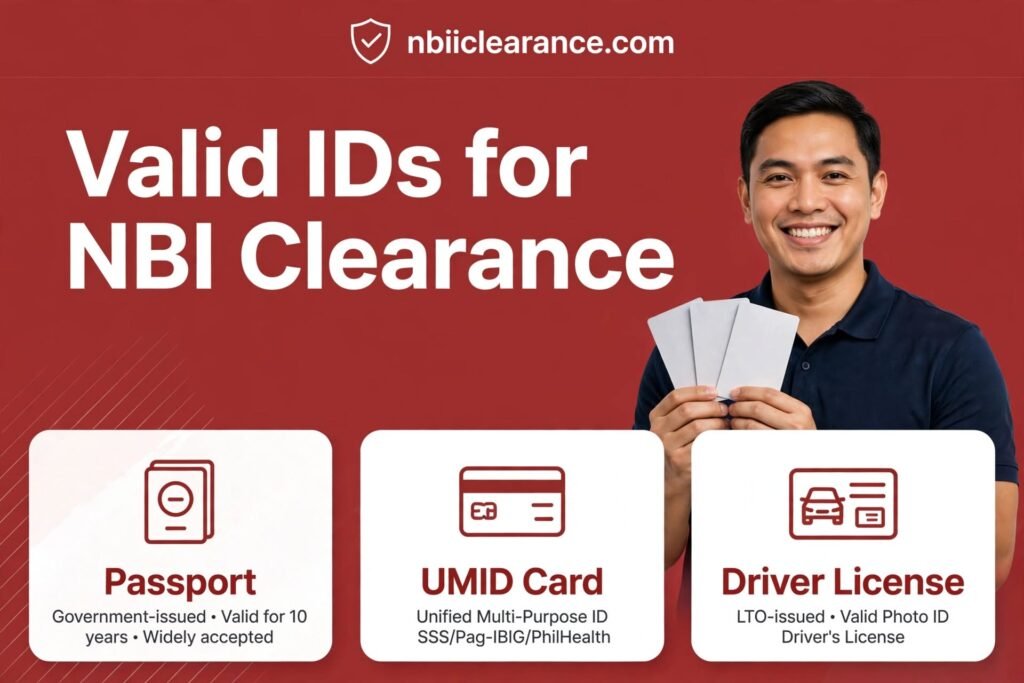
Valid IDs for NBI Clearance
The Complete 2026 List and Guide
Of everything that can hold up an NBI clearance appointment the wrong ID is probably the single biggest culprit. Not because people don’t bring identification almost everyone does but because a lot of applicants assume any card with their name and photo on it will do the job. It won’t always. The NBI has a specific list of accepted government-issued IDs and cards that fall outside that list or that look valid but are missing a detail like an expiration date can turn a quick fifteen-minute appointment into a wasted trip.
This guide goes through every commonly used ID in the Philippines, explains whether it works for an NBI clearance application and covers the small details like plastic versus paper versions that decide whether a card gets accepted or turned away at the counter.
For more helpful information about NBI Clearance requirements list 2026 explore our NBI Clearance Blog for related guides, helpful tips, and the latest updates.
Why the ID You Bring Matters So Much
An NBI clearance exists to confirm that the person named on the certificate is genuinely who they claim to be with no pending criminal case tied to their identity. That confirmation only works if the ID presented at the branch reliably proves identity in the first place which is exactly why the requirement is treated so consistently across branches rather than left to loose interpretation. This is why the NBI does not accept just anything with a name printed on it. A valid ID in this context means an original government-issued unexpired card that includes a clear photo and full legal name matching what was entered during online registration.
Two IDs are generally required rather than one since a second document acts as a backup confirmation in case the first is questioned unclear or borderline in condition. Bringing two also protects you if a specific branch happens to be stricter about a particular ID type that another branch might accept without issue.
Primary IDs That Are Almost Always Accepted
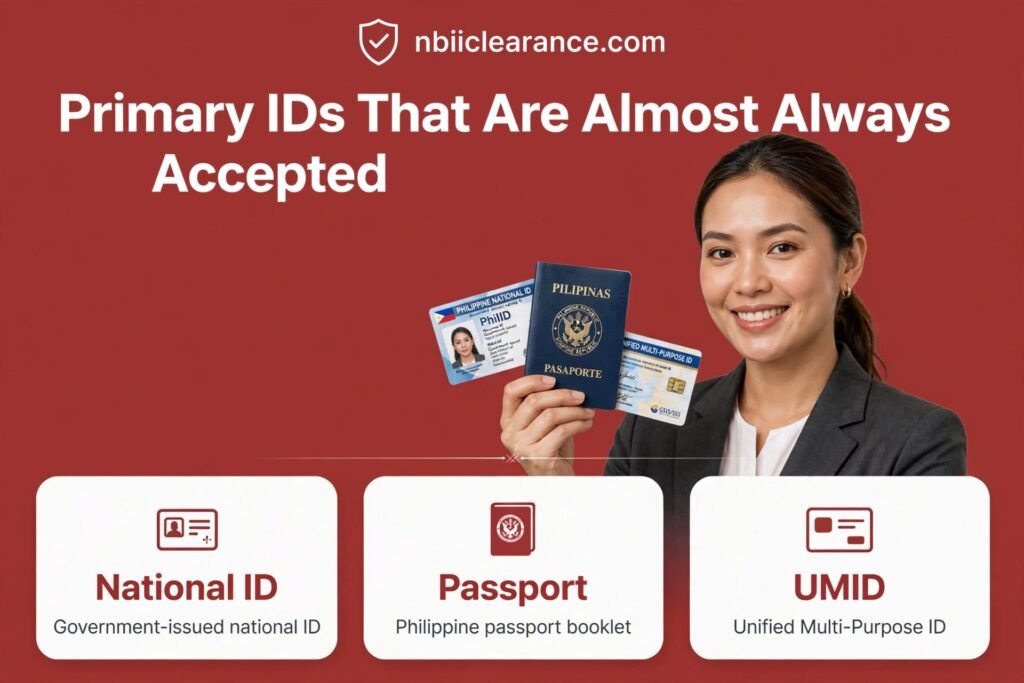
A handful of IDs are considered strong reliable choices at essentially every NBI branch since they are widely recognized and difficult to forge and issued by well-established government agencies.For the latest and official information please visit the official NBI website.
Philippine Passport.
This is arguably the single most trusted ID for NBI clearance purposes since it contains your full legal name, photo , birthdate and nationality all verified through a rigorous issuance process. It must be unexpired and many branches prefer to see at least a few months of remaining validity rather than a passport about to lapse.
PhilSys National ID
Whether in physical card form or as the digital ePhilID the national ID has become one of the more commonly accepted primary IDs in recent years since it is designed specifically to serve as a universal identification document across government transactions.
UMID (Unified Multi-Purpose ID)
Because it links across SSS GSIS PhilHealth and Pag-IBIG records the UMID carries strong verification value and is widely accepted. If you are employed or have contributed to any of these systems this is often one of the easiest primary IDs to have on hand.
Drivers License (LTO-issued)
Only the official plastic card version is reliably accepted. A paper temporary permit sometimes issued while a physical card is being processed is frequently refused so if this is the only license format you currently have it is worth checking with your specific branch beforehand or bringing a second more clearly accepted ID as backup.
PRC ID
For licensed professionals a current and unexpired Professional Regulation Commission ID is generally accepted without issue since it is tied to a verified professional license record
Secondary and Situational IDs
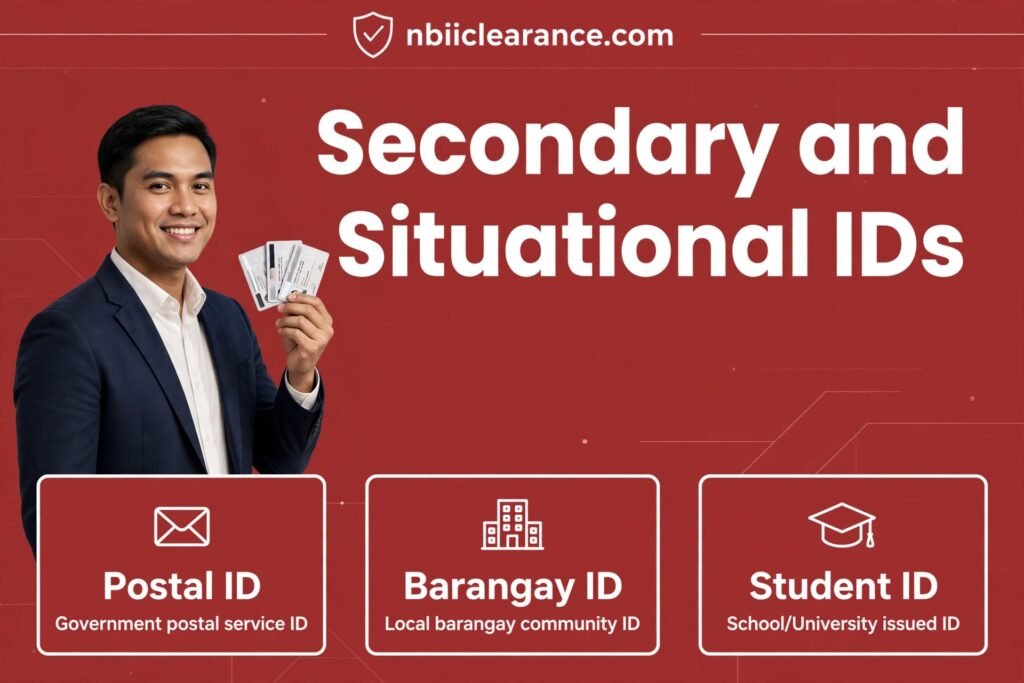
These IDs are commonly accepted as well though they sometimes work better paired with one of the primary IDs above rather than standing entirely on their own.
Postal ID
A frequently used option for applicants who do not yet have a passport or drivers license since it is relatively accessible to obtain and widely recognized across government transactions.
Voters ID or Certificate of Registration
Generally accepted though availability and acceptance can vary slightly depending on the branch and how recently the voters registration was processed.
PhilHealth ID
Often accepted as a secondary or backup ID particularly useful if paired with a stronger primary ID like a passport or UMID.
Senior Citizen ID
Accepted for applicants who qualify issued through local government units and generally recognized nationwide.
PWD ID
Similarly accepted for qualifying applicants issued by local government units and recognized as valid government identification.
PSA-Authenticated Birth Certificate
This can serve as one of your two required IDs particularly useful for applicants who are still working on obtaining a photo-bearing ID. It works best when paired with a card that does carry a photo, since the birth certificate itself does not include one.
Government Employee ID
Accepted for applicants currently employed in government service since it is issued directly by a government agency and typically includes standard identification details.
Seamans Book or MARINA ID
Relevant specifically for applicants working in the maritime industry these are generally accepted given their status as government-issued identification tied to a recognized profession.
Security License ID
Issued to licensed security personnel this ID is generally accepted for applicants working in that specific field.
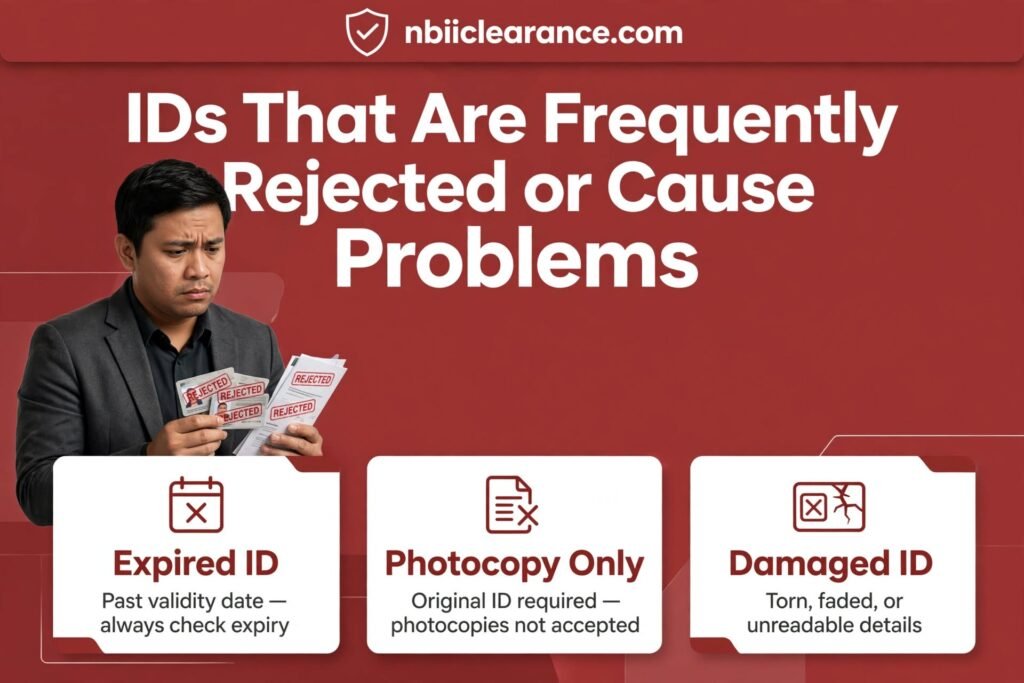
IDs That Are Frequently Rejected or Cause Problems
Just as important as knowing what works is knowing what tends to cause trouble since a few commonly carried cards are not treated the way people expect.
Barangay ID
Despite being government-issued at the local level a barangay ID is generally not accepted as one of the two required primary IDs. It may occasionally be accepted as a last-resort supporting document alongside a stronger ID but it should not be relied on as a main identification card.
Barangay Clearance or Certificate
This is a document confirming residency or standing within a barangay not an identification card and is not accepted as an ID at all regardless of how official it looks.
Old Laminated Paper TIN ID
The older paper version of the Tax Identification Number card is frequently rejected. Only the newer plastic TIN card with a photo is accepted at some branches and even then acceptance can vary so it is safer not to rely on this as a primary ID.
Company or School ID (for adults)
A standard employee ID from a private company or a school ID for an adult student generally does not meet the government-issued requirement since these are issued by private institutions rather than a government agency. The exception is a minor applicant where a school ID paired with a birth certificate and a guardians ID is sometimes accepted covered in more detail further below.
Expired Versions of Any Accepted ID
Regardless of how minor the lapse, an expired ID is generally refused outright. Even an ID that expired a week ago is treated the same as one that expired years ago at most branches.
Photocopies Screenshots or Digital Photos of an ID
No matter how clear the image, these are not accepted as substitutes for the original physical card. Some digital government IDs like an ePhilID are treated differently since they are designed to function as a standalone digital format but a screenshot or photo of a physical card is not the same thing and is generally refused.
Comparing the Strongest ID Options at a Glance
| ID | Strength as Primary ID | Common Issue to Watch For |
|---|---|---|
| Philippine Passport | Very strong | Must have sufficient remaining validity |
| PhilSys National ID | Strong | Physical card availability still varies by region |
| UMID | Strong | Card must be undamaged and clearly readable |
| Driver's License | Strong plastic card only | Paper temporary permits often refused |
| PRC ID | Strong for licensed professionals | Must be current, not an expired license |
| Postal ID | Moderate, works well as one of two | Older paper versions may be questioned |
| Voter's ID | Moderate | Acceptance varies slightly by branch |
| PSA Birth Certificate | Moderate, best paired with a photo ID | Does not include a photo on its own |
| Barangay ID | Weak, avoid relying on this alone | Often not accepted as a primary ID |
What Makes an ID "Valid" in the NBIs Eyes
It helps to understand the underlying standard the NBI applies rather than memorizing a list alone since new ID types occasionally appear and older ones get phased out. Generally a valid ID needs to be issued by a government agency rather than a private company, include a clear photo of the holder, display the full legal name matching official records and remain unexpired at the time of the appointment. IDs that meet all four of these conditions tend to be accepted even if they are not among the most commonly used examples while cards missing even one of these elements are likely to run into trouble at the counter.
This standard is also why some newer or less common government IDs not always covered explicitly in general guides can still work perfectly well as long as they check these boxes and it is why an ID that looks impressive but fails on even one of these points such as a private company card with no government backing will still be turned away regardless of how official it appears.
Choosing Which Two IDs to Bring
If you have several options available it is worth thinking strategically about which two to bring rather than grabbing whatever is closest at hand. Pairing your strongest primary ID such as a passport or UMID with a second solid option like a PhilSys National ID or PRC ID gives you the least room for any question at the counter. If your strongest option is something more situational like a PSA birth certificate pairing it with any available photo-bearing ID rounds out the pair more reliably than presenting two weaker documents together.
For applicants with only one strong ID available, bringing a genuinely weaker backup, even a Postal ID or Senior Citizen ID is still better than showing up with just one document since having a second option on hand gives staff room to work with if the first ID raises any concern.
IDs for Overseas Filipino Workers
OFWs generally rely on the same accepted ID list as domestic applicants with a passport carrying particular weight given how central it is to working abroad in the first place. A UMID or PRC ID if applicable to their profession also works well as a second option. Some OFWs additionally carry an OFW ID or an Overseas Employment Certificate which can serve as useful supporting documentation though a standard valid ID from the main accepted list is still typically required for the core identification requirement.Particularly a passport has enough remaining validity to comfortably cover both the
Applicants renewing from abroad should double-check that whichever ID they plan to use the application process and any delivery timeline since a passport nearing expiration during that window could complicate things unnecessarily.
IDs for Foreign Nationals
Foreign nationals applying for an NBI clearance while residing in the Philippines follow a different identification path. The Alien Certificate of Registration commonly called the ACR I-Card is the primary identification document expected in this case generally presented alongside a valid passport from the applicant’s home country. This combination reflects both the applicant’s legal residency status in the Philippines and their underlying national identity which is why both documents are typically requested together rather than either one alone.
IDs for Minors and Underage Applicants
Since most NBI clearance applicants are adults, ID options for minors are naturally more limited. A school ID is commonly accepted for a minor applicant but generally only when paired with a PSA-authenticated birth certificate confirming the child’s identity and birthdate along with the valid ID of an accompanying parent or legal guardian. This layered requirement exists because a school ID alone issued by a private or public educational institution rather than a government agency would not meet the standard applied to adult applicants on its own.
Because requirements for minors can vary somewhat more than the standard adult process, confirming the exact expected combination directly with your chosen branch or through the official portal is worth doing before the appointment if you are applying on behalf of a child.
What to Do If Your Only IDs Are Borderline or Unclear
Sometimes the ID you have is technically on the accepted list but is in poor physical condition, faded, cracked or difficult to read clearly. Rather than risk a rejection at the counter it is worth requesting a replacement or renewal of that specific ID ahead of time if you have enough lead time before your NBI appointment. If time is tight, bringing a second clearer ID alongside the questionable one gives staff a fallback option to verify your identity even if the primary card raises a question.
If none of your current IDs feel entirely solid a PSA-authenticated birth certificate is often one of the more reliable options to fall back on relatively quickly since it can typically be requested and delivered within a reasonable window especially compared to documents like a passport that require a longer processing timeline from application to release.
Digital and Physical Format: Why It Matters
A recurring point of confusion involves digital versions of IDs particularly as more government identification moves toward app-based or QR-code formats. The general rule at NBI branches has remained that a physical card is the expected format for most accepted IDs with the notable exception of certain officially issued digital IDs like the ePhilID which are designed from the outset to function as valid standalone identification without a physical card.
A photo or screenshot of a physical ID stored on your phone is a different situation entirely and is not treated the same as an officially issued digital ID. If you are unsure whether a specific digital format will be accepted, checking directly with the branch or the official portal before your appointment avoids an unpleasant surprise on the day itself.
How ID Requirements Connect to Preventing a Data Mismatch
Beyond simply proving who you are, your chosen ID plays a direct role in avoiding what is sometimes informally called a data mismatch where the details you entered online do not line up with what is printed on your physical ID. This is different from a criminal record hit but it can cause a similar kind of delay if not caught early.
Before your appointment it is worth comparing your online registration entry field by field against the exact ID you plan to bring. Full name including middle name and any suffix birthdate and birthplace should match precisely. If you notice a discrepancy before your appointment, correcting it through your account ahead of time is far easier than trying to resolve it at the branch counter on the day itself.
Why Two IDs Instead of One Adds Real Protection
It is worth spending a moment on why the two-ID rule exists at all rather than treating it as an arbitrary inconvenience. A single ID no matter how official it looks can theoretically be lost, stolen or in rare cases altered. Requiring a second independently issued document from a different source makes that kind of misuse considerably harder to pull off since someone would need to successfully forge or obtain two separate government-issued cards rather than just one.
This layered approach also protects honest applicants from simple mistakes. If one ID happens to have a printing error, a slightly outdated photo or damage that makes a detail hard to read, the second ID gives staff another way to confirm the applicant’s identity without having to turn them away entirely. In that sense the requirement works in your favor as much as it works as a safeguard against fraud.
How Branch-Level Judgment Can Affect Borderline Cases
Even with a fairly consistent national policy individual staff members do exercise some judgment when an ID falls into a gray area such as a card that is technically still valid but visibly worn or a less commonly seen ID type that is not explicitly listed but does meet the general standard of being government-issued photo-bearing and current. In these situations having a second clearly strong ID on hand tends to resolve any hesitation quickly since staff can simply verify identity through the stronger document while noting the other as supporting information.
This is also why it rarely pays off to gamble on a single questionable ID even if a friend or family member mentions it worked for them at a different branch on a different day. Policies applied consistently at the national level can still be interpreted slightly differently in practice depending on the specific staff member and branch so bringing your strongest realistic combination remains the safer approach regardless of what worked for someone else.
A Closer Look at Regional and Provincial ID Variations
Applicants outside major cities sometimes have access to slightly different local identification options and it is worth knowing how these generally fit into the picture. Some provinces issue their own local government identification cards beyond the standard senior citizen or PWD categories and while these are technically government-issued they are not always as widely recognized as the nationally standardized options like a passport UMID or PhilSys ID.
If your available identification leans heavily on a local or less common government card it is worth treating it as a supporting document rather than your primary choice whenever a more nationally recognized ID is available to you instead. When it is genuinely your best or only option, confirming its acceptance with your specific branch ahead of time saves you from an unnecessary trip if that particular office happens not to recognize it.
Replacing a Lost or Damaged Primary ID Before Your Appointment
If your strongest ID has been lost, stolen or damaged beyond a usable condition it is worth starting the replacement process well ahead of your NBI appointment date rather than assuming a backup ID alone will be enough. Passport replacement for instance can take considerably longer than replacing a UMID or Postal ID so timing matters depending on which document you are missing.
In the meantime a police report or affidavit of loss for the missing ID while not a substitute identification document itself can sometimes help explain the situation if a staff member asks why a particular ID is not being presented especially for renewal applicants whose past record already exists in the system and simply needs to be confirmed rather than newly verified.
Frequently Asked Questions
Which single ID is considered the strongest option for NBI clearance?
A Philippine passport is generally regarded as the strongest option since it combines a verified issuance process with a clear photo, full legal name, and nationality all in one widely recognized document.
Can I use my company ID as one of my two required IDs?
Generally no. A standard employee ID issued by a private company does not meet the government-issued requirement. A government employee ID is different and is typically accepted since it is issued by a government agency rather than a private employer.
Is the PhilSys National ID accepted everywhere yet?
It is widely accepted as a primary ID at most branches though physical card availability has varied somewhat by region as the national rollout continues so it helps to have a backup ID ready if your card is still pending.
Does my drivers license need to be a plastic card or can I use the paper receipt?
Most branches accept only the official plastic card. A paper temporary permit or receipt issued while the plastic card is being processed is frequently refused so it is safer to bring a different ID if you do not yet have the physical license card.
Can I use a PSA birth certificate as my only ID?
It is generally accepted as one of your two required IDs but works best paired with a photo-bearing ID since the birth certificate itself does not include a photograph to visually confirm your identity.
Are digital or app-based IDs accepted at NBI branches?
Officially issued digital IDs designed to function as standalone identification such as the ePhilID are generally accepted. A photo or screenshot of a regular physical ID stored on your phone is not treated the same way and is typically not accepted.
What happens if my ID is valid but the photo looks very different from how I look now?
Staff generally allow for natural changes in appearance over time but a significant difference can sometimes prompt additional questions. Bringing a second ID with a more recent photo can help resolve any uncertainty quickly if this comes up.
Can a foreign national use just their passport without an ACR I-Card?
Generally no. Foreign nationals residing in the Philippines are typically expected to present their ACR I-Card alongside their passport, since the ACR I-Card confirms their legal residency status specifically within the country.
Is a Barangay ID ever acceptable even as a backup?
It is generally not treated as one of the two required primary IDs and relying on it as your main identification is risky. If you have no stronger alternative, checking directly with your specific branch beforehand is worth doing rather than assuming it will be accepted.
What should I do if I only have one strong ID and nothing else?
A PSA-authenticated birth certificate or a Postal ID are usually the more accessible options to obtain on relatively short notice and pairing either with your one strong ID typically satisfies the two-ID requirement in the meantime.
Can I use a local government-issued ID that is not on the common accepted list?
Sometimes though it depends on the specific card and the branch reviewing it. Locally issued IDs beyond the standard national options are generally treated as supporting documents rather than a primary choice so it is worth confirming with your branch beforehand if this is your strongest available option.
Does the order in which I present my two IDs matter?
Not really. Staff typically review both together rather than treating one as more important based on which is handed over first. It is more useful to simply present your strongest clearest ID alongside your second choice without worrying about sequence.
Final Thoughts
The list of accepted IDs for an NBI clearance is not arbitrary; it reflects a straightforward standard: a government-issued unexpired, photo-bearing document that clearly confirms who you are. Once that standard is clear in your mind, deciding which two cards to bring becomes far less confusing than trying to memorize an exhaustive list from memory.
A useful habit going forward is to keep at least two of your strongest IDs such as a passport and a UMID or PhilSys card current and unexpired at all times rather than scrambling to renew one only when an NBI appointment happens to be coming up. Since these same documents tend to be requested across many other government and financial transactions as well, keeping them fresh pays off well beyond just this one process.
Because ID rules and newly recognized formats like digital national IDs continue to evolve it is worth a quick check on the official NBI portal close to your appointment date if you are relying on anything outside the most common passport UMID or drivers license combination.
Information last reviewed August 2026. Accepted ID lists and requirements may change over time; always confirm current details on the official NBI Clearance website before your appointment since this is the detail most likely to be updated between one application and the next.
Pingback: Complexion in NBI Clearance Form – What to Write & Examples